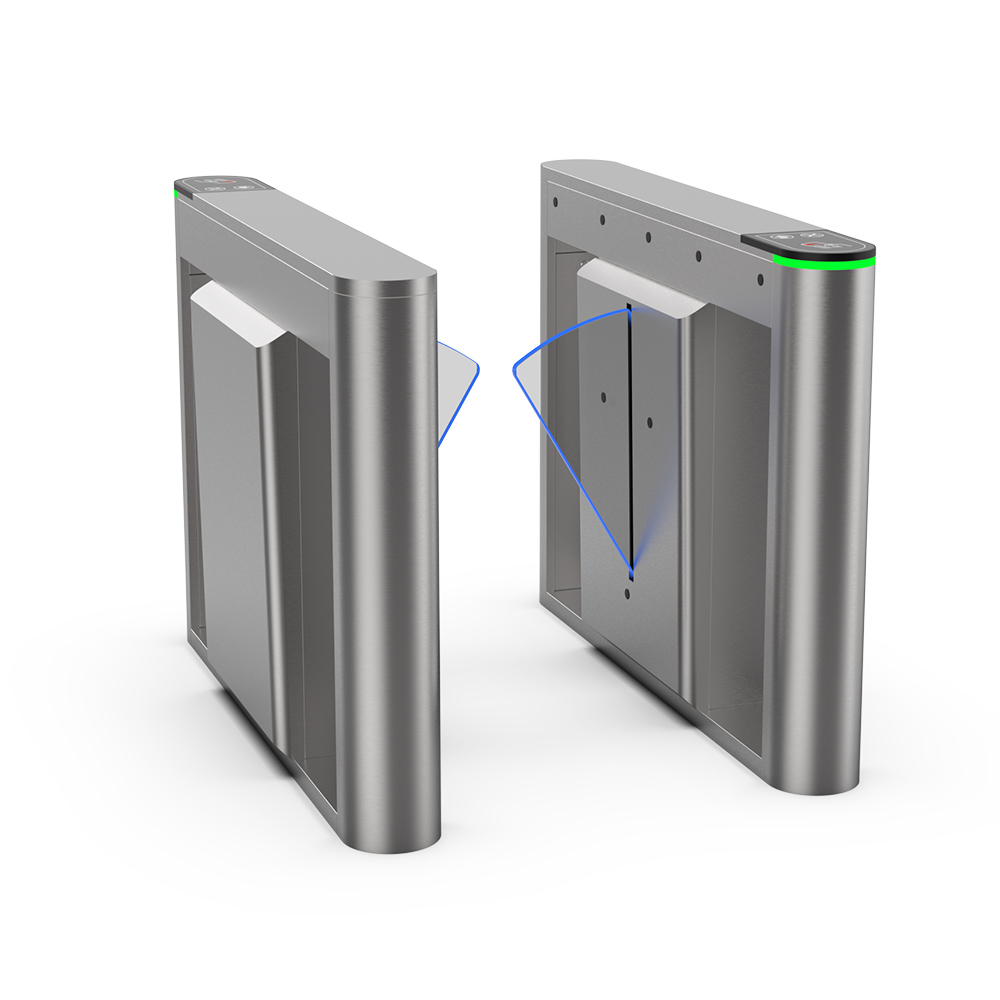
RFID cards, QR codes and face recognition are three of the most common identity verification methods used with modern turnstile access control systems. The best option depends on who will use the entrance, how frequently credentials change, the required pedestrian throughput, security expectations and the existing access control infrastructure.
In general, RFID turnstiles are well suited to regular employees and members, QR code systems are flexible for visitors and temporary access, while a face recognition turnstile can provide fast, contactless identity verification for controlled entrances. Many projects also combine two or more credential methods instead of relying on a single technology.
| Quick AnswerChoose RFID for frequent repeat users, QR codes for visitors and temporary credentials, and face recognition when contactless identity verification and user convenience are priorities. For higher-security projects, credential selection should also consider access permissions, anti-passback rules, visitor management, system integration and emergency operation rather than the reader technology alone. |
The three technologies solve different access control problems. The following comparison provides a practical starting point before selecting credential readers, access controllers and turnstile hardware.
| Factor | RFID | QR Code | Face Recognition |
|---|---|---|---|
| Typical Users | Employees, residents, members | Visitors, guests, ticket holders | Employees and registered users |
| Credential | Card, key fob or compatible credential | Printed or mobile QR code | Registered facial template |
| Contactless Use | Yes | Yes | Yes |
| Temporary Access | Possible, but credentials must be issued | Excellent | Usually requires enrollment |
| Repeat Users | Excellent | Good | Excellent |
| Main Advantage | Mature credential management | Easy issuance and expiration | Credential-free user experience |
| Typical Application | Factories, offices, residential facilities | Events, visitor access, commercial buildings | Offices, campuses, controlled facilities |
An RFID turnstile uses a card, key fob or another compatible contactless credential to identify an authorized user. The reader sends credential information to the access controller, which checks the user's permission before sending an opening signal to the turnstile.
RFID is particularly effective where the same users enter repeatedly. Employee entrances, factories, office buildings, residential communities, gyms and campuses are common examples. Administrators can assign different access levels, deactivate lost credentials and review passage records through the connected access control platform.
Contactless proximity card technologies may use standards from the ISO/IEC 14443 family, which defines communication characteristics for proximity cards and contactless objects. However, buyers should confirm the exact card technology, frequency, reader protocol and controller compatibility required by their project rather than assuming every RFID reader and credential are interchangeable.
Most users enter the facility regularly.
An RFID access control system is already installed.
User permissions need to be centrally managed.
Credentials need to be added, removed or reassigned easily.
The project requires a familiar and straightforward access workflow.
The main limitation is credential management. Cards can be lost, forgotten or potentially shared with another person. Projects requiring stronger identity assurance may therefore combine RFID with another authentication method.
A QR code turnstile verifies a digital or printed code presented at the entrance. QR credentials can be generated remotely and configured with a defined validity period, making them particularly useful where access permissions frequently change.
For example, a visitor management system can issue a QR code after registration. The visitor receives the code on a smartphone, scans it at the turnstile, and the connected system checks whether that credential is valid for the specified entrance and time period.
The QR Code symbology itself is standardized under ISO/IEC 18004:2024. For access control projects, however, security depends not only on the QR symbol but also on how credentials are generated, validated, expired and connected to the access management platform.
Temporary visitors and contractors
Event and ticket-based entrances
Commercial building visitor management
Pre-registered appointments
Applications where physical cards are inconvenient to issue
For higher-control applications, consider whether QR credentials should support expiration times, one-time use, server-side validation or anti-reuse rules. A static QR image that can simply be forwarded to another person offers a very different level of control from a dynamically issued credential tied to a visitor management system.
A face recognition turnstile combines a turnstile gate with a biometric terminal capable of comparing a live facial image with an enrolled identity template. After successful verification and authorization, the access control system releases the gate for passage.
A turnstile with face recognition removes the need for users to present a physical credential, which can make passage more convenient for frequent users. It may also reduce operational problems caused by forgotten cards or deliberate card sharing.
Facial recognition performance can vary significantly between algorithms and operating conditions. The U.S. National Institute of Standards and Technology maintains independent Face Technology Evaluations covering face recognition and face analysis technologies. For project procurement, buyers should evaluate the actual biometric terminal and operating environment rather than relying only on a generic accuracy claim.
For projects requiring stronger identity verification, a turnstile gate with face recognition may also be combined with RFID or another credential to create multi-factor access workflows where appropriate.
There is no single answer because access security depends on the entire system rather than one reader. A face recognition terminal may provide stronger identity binding than a transferable card, but poor enrollment or weak terminal configuration can still reduce system effectiveness. Similarly, an RFID credential may be sufficient for ordinary staff access but may need additional controls for higher-security areas.
| Security Question | RFID | QR Code | Face Recognition |
|---|---|---|---|
| Can the credential be shared? | Possible | Possible unless controlled by the system | More difficult |
| Can access expire automatically? | Yes, through access permissions | Yes | Yes, through access permissions |
| Identity tied directly to person? | Not inherently | Not inherently | Yes, when properly enrolled |
| Best security improvement | Strong credential management | Dynamic / expiring validation | Quality biometric terminal and enrollment |
For higher-security entrances, also consider anti-passback rules, tailgating detection, passage sensors, alarm logic and whether two credentials should be required for specific user groups.
There is no universal credential method for every entrance. Selection should start with the user group and operational workflow rather than the reader itself.
| Application | Recommended Method | Why |
|---|---|---|
| Factory Employees | RFID or RFID + Face | Repeat users and centralized permission management |
| Office Employees | RFID or Face Recognition | Fast daily access with managed identities |
| Office Visitors | QR Code | Temporary credentials can be issued remotely |
| Events / Ticketing | QR Code | Integrates naturally with digital ticket workflows |
| Campus / Controlled Facility | RFID + Face Recognition | Supports identity verification and differentiated permissions |
| Mixed Staff + Visitor Entrance | Multi-Credential Reader | Employees can use RFID or face while visitors use QR codes |
A common procurement mistake is choosing the reader first and treating the turnstile as a secondary component. In practice, the complete entrance system should be selected according to pedestrian flow, security level, passage width, accessibility, emergency behavior and the type of users passing through the lane.
For example, a tripod turnstile can provide cost-effective controlled access for factories and staff entrances, while speed gates and swing gates may be more suitable for commercial environments where passage experience or wider lanes are priorities.
If you have not yet selected the gate structure, compare the main turnstile types by security level, traffic capacity, passage width and application before choosing the authentication method.
Projects that already use tripod gates can also refer to our tripod turnstile access control integration guide for more detailed information about connecting turnstiles with existing access control systems.
Yes, depending on the selected turnstile, controller and reader configuration. A single entrance lane can be designed to accept different credentials for different user groups. For example, employees may use RFID cards or face recognition while visitors receive temporary QR codes.
The important point is that multi-credential capability should be treated as a system integration requirement, not simply a reader feature. Before ordering, confirm reader mounting space, power requirements, controller inputs and outputs, communication interfaces and how each credential type is processed by the management software.
| Example: A commercial office entrance may allow employees to pass using RFID or face recognition, issue time-limited QR credentials to visitors, and send all successful and rejected access events to the same management platform. |
Before requesting a quotation, define both the physical entrance requirements and the identity verification workflow. This helps the supplier recommend compatible turnstile hardware, readers, controllers and communication interfaces.
Project RFQ Checklist
|
For larger projects, it is usually better to confirm the complete entrance architecture before finalizing individual devices. This reduces compatibility problems between the turnstile, credential reader, controller and management software.
RFID is generally simpler for established card-based access systems, while face recognition removes the need to present a physical credential. The better choice depends on identity assurance, user convenience, privacy requirements and existing infrastructure.
Yes. Many turnstile projects can integrate multiple credential readers, provided the selected controller, interfaces and physical mounting configuration are compatible. The exact combination should be confirmed for the selected turnstile and project configuration.
QR codes are often practical for visitor access because credentials can be issued remotely and configured to expire automatically. Permanent users may be better served by RFID cards or registered biometric credentials.
Potentially yes, but compatibility depends on the biometric terminal, controller, communication interface and existing software. These should be confirmed before procurement rather than assuming that every terminal and access controller can communicate directly.
Yes, if the connected access or visitor management system supports one-time validation. The system can invalidate the credential after successful passage or after a specified expiration time.
They should ideally be selected together. Passage width, pedestrian capacity and security requirements determine the suitable turnstile structure, while the user workflow determines whether RFID, QR codes, face recognition or a combination is more appropriate.
For buyers and system integrators who need to verify technical standards or evaluate authentication technologies in more detail, the following authoritative resources may be useful:
DOOR can help evaluate turnstile type, passage requirements and RFID, QR code or biometric access control integration for commercial and industrial entrance projects. Provide your lane quantity, authentication method, existing system details and project requirements for a project-specific recommendation.
Contact DOOR

Headquarters Add.
Factory Add.
Come and Contact DOOR
Quick Links
17th Floor, Block C, Digital Innovation Center, Longhua District, Shenzhen, China
 EN
EN