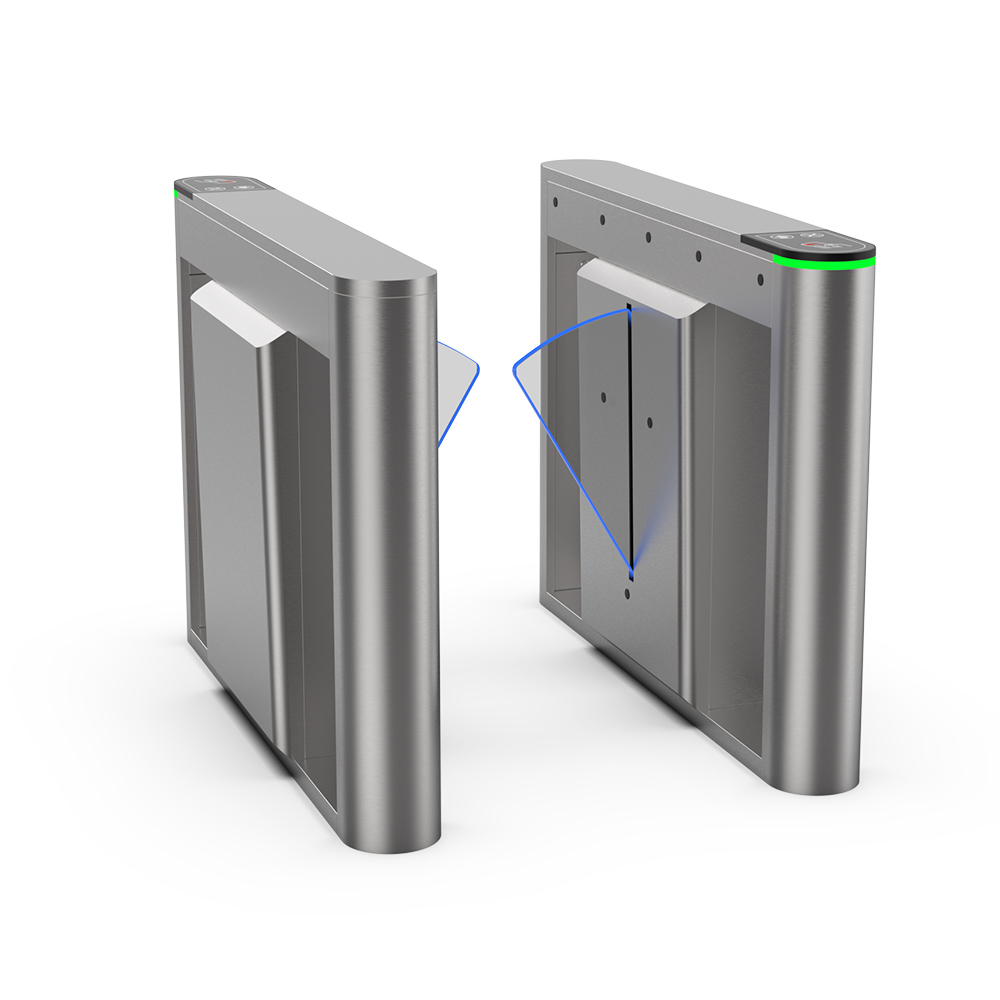
A tripod turnstile access control system combines a three-arm pedestrian barrier with a credential reader, access controller and management software. It allows an authorized user to pass after an RFID card, QR code or biometric credential has been verified. The system can control entry and exit direction, record access events and connect with compatible attendance, visitor or security platforms.
Quick answer: A user presents a credential, the reader sends the credential data to the controller, and the controller checks the access rule. If access is approved, a relay or communication command unlocks the tripod mechanism for one passage. After rotation, the gate returns to its locked position and the event can be stored in the management software. The exact sequence, interfaces and emergency behavior depend on the selected turnstile, controller and project configuration.
Tripod security gates are commonly used where controlled, single-person pedestrian passage is more important than a wide, barrier-free lane. Typical projects include factories, construction sites, office attendance entrances, stations, stadiums and institutional facilities. If you are still choosing the barrier format, compare the types of turnstile gates before selecting the access control hardware.
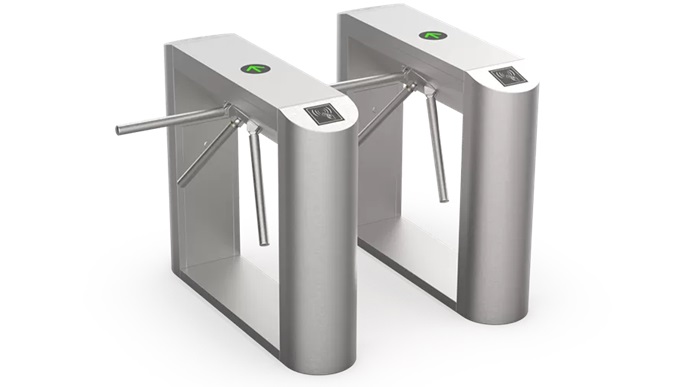
The turnstile is the physical lane-control device; authorization is normally handled by a separate reader and access controller. A typical access transaction follows five steps:
Credential presentedThe user taps a card, scans a QR code or uses an approved biometric reader.
Identity checked The reader or controller captures the credential and checks it against the configured system.
Permission decidedAccess rules such as user status, time zone, door group and direction are evaluated.
Turnstile released An approved command unlocks one direction so the user can rotate the arm and pass.
Event recordedThe passage or denial event can be sent to compatible management software for reporting.
A properly designed tripod access control system therefore involves more than the gate cabinet. Reader technology, controller logic, network design, power supply, software and safe site operation all affect the final result.
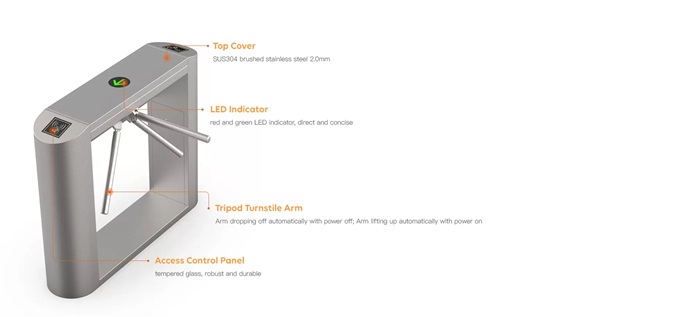
| Component | Primary function | What to confirm before ordering |
|---|---|---|
| Tripod turnstile | Controls the physical lane and limits passage to one rotating-arm cycle. | Cabinet size, lane width, direction, mechanism, operating environment and arm-drop configuration. |
| Credential reader | Reads an RFID card, QR code, mobile credential, fingerprint or face credential. | Credential format, read distance, mounting position, environmental rating and controller compatibility. |
| Access controller | Applies permissions and sends the release command to the selected direction. | Number of lanes, input/output points, communication protocol, offline behavior and anti-passback support. |
| Management software | Manages users, schedules, access zones, visitor credentials, alarms and event reports. | API or SDK availability, database ownership, user capacity and integration with existing platforms. |
| Power and network | Supplies the turnstile, reader and controller and connects them to the management system. | Voltage, power budget, cable route, grounding, surge protection, UPS requirement and network topology. |
| Emergency interface | Receives a configured fire-alarm, emergency or power-loss signal and changes the lane state. | Model-specific arm behavior, interface logic, local safety plan and acceptance requirements. |
The correct credential method depends on who uses the entrance, how frequently credentials change and how the organization manages identity. The turnstile can provide the same physical passage function while different readers and software handle authorization.
| Method | Best suited to | Advantages | Points to evaluate |
|---|---|---|---|
| RFID card or fob | Employees, contractors and repeat users | Fast, familiar and suitable for frequent daily use | Card issuance, replacement, credential format and card-sharing controls |
| QR code | Visitors, tickets and temporary access | Easy digital distribution and flexible time-limited credentials | Screen brightness, scanner angle, duplicate-code control and offline validation |
| Face or fingerprint | Projects requiring identity-linked verification | Reduces dependence on a physical card | Consent, privacy, enrollment, recognition conditions and local data-protection requirements |
For a more detailed project comparison, read RFID vs QR code vs face recognition for turnstile access control.
A tripod gate can often be integrated into an existing platform, but compatibility should be checked at signal, credential and software levels. Common integration points may include:
A relay or dry-contact output can send an open command for entry or exit. Confirm pulse duration, normally open/normally closed logic and direction mapping.
Readers may connect to the controller through Wiegand, RS-485, OSDP or another supported interface. The selected reader and controller must use compatible protocols.
TCP/IP, an API or an SDK may be used for user data, visitor workflows and event exchange. Availability and supported functions vary by controller and software platform.
Passage, rotation, forced-entry or emergency status may be monitored when the selected model and controller provide the necessary inputs and outputs.
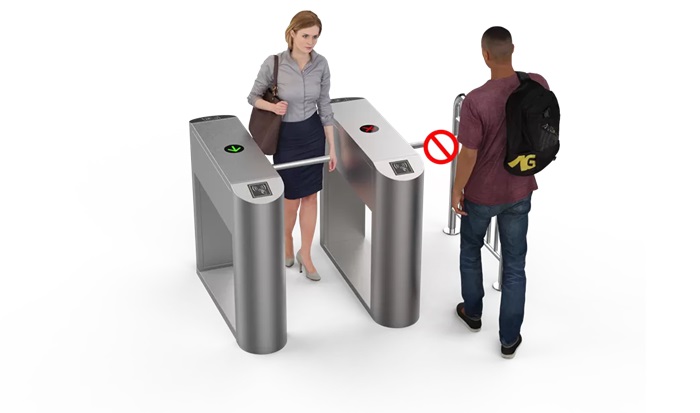
A lane may be configured for entry only, exit only or bidirectional access, depending on the mechanism and controller setup. Time-zone rules can allow specific users or groups to enter during approved periods. Anti-passback can prevent the same credential from being used repeatedly in the same direction, but it normally requires controller/software support, reliable entry-and-exit event data and readers arranged for the required directions.
Integration note: Do not select a turnstile only from a protocol name on a brochure. Provide the supplier with the reader model, controller model, wiring diagram, credential format, software/API requirement and intended lane logic so that compatibility can be confirmed before production.
Some tripod turnstile models can be configured with a drop-arm function. When the designated emergency input or defined power condition is triggered, the horizontal arm can drop to reduce obstruction. The trigger method and reset procedure are model- and configuration-specific, so they must be confirmed in the electrical drawings and commissioning test.
A tripod lane is not a substitute for an approved emergency exit, and its standard passage is generally unsuitable for wheelchairs, large luggage or some mobility needs. Projects should normally provide a separate accessible swing-gate lane or another compliant route where required. Final egress and accessibility arrangements must follow the project design and applicable local requirements.
Outdoor use also requires configuration-level confirmation. Ask about cabinet material, surface treatment, reader enclosure rating, drainage, shelter, operating temperature, power protection and the environmental rating of the complete assembled system—not only one component.
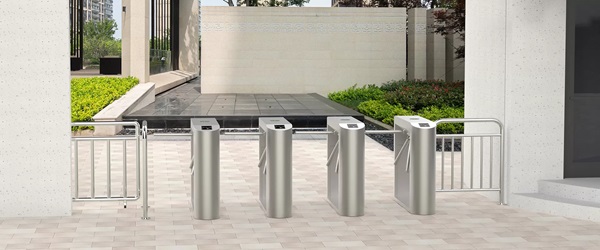
A tripod gate is usually selected for compact, controlled passage and practical project cost. Other barrier types may be more suitable when the entrance needs a wider lane, stronger perimeter resistance or a different visual and traffic-flow profile.
| Gate type | Typical strength | Important limitation or design point |
|---|---|---|
| Tripod turnstile | Compact single-person control for routine employee, contractor or ticketed access | Standard lane is not suitable for wheelchairs or large luggage; supervised use may still be needed to manage tailgating |
| Swing gate | Can provide a wider passage for accessible access, carts or luggage | Leaf width, opening clearance, safety sensors and tailgating controls require careful design |
| Full-height turnstile | Higher physical perimeter control for unsupervised or restricted areas | Larger footprint and a more enclosed passage experience; separate accessible and emergency routes may be required |
| Flap or speed gate | Fast, sensor-managed flow and a modern appearance for indoor lobbies or transit environments | More sensors and moving parts can increase system complexity, commissioning needs and project cost |
Link employee credentials with access permissions or attendance records while keeping entry and exit movement organized.
Control contractor access and record site attendance. For higher perimeter security, compare tripod and full-height construction site turnstiles.
Manage authorized staff or ticketed users where the expected flow, lane layout and credential-reading time suit a rotating-arm gate.
Combine ticket or credential validation with single-person lane control, while providing separate routes for accessible entry and emergency operation.
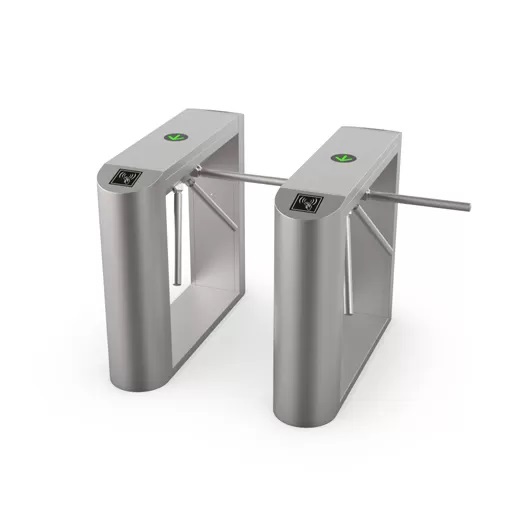
Before requesting a quotation, define the following details. A complete brief helps the supplier recommend the appropriate tripod turnstile models and confirm integration requirements.
Site and quantity: indoor or outdoor location, number of lanes and available floor dimensions.
Users and traffic: expected users per day, peak-period demand and entry/exit direction.
Credential method: RFID format, QR source, mobile credential or biometric reader model.
Existing system: controller, software, database, API/SDK and required event fields.
Lane requirements: standard passage width plus separate accessible, luggage or delivery access.
Safety behavior: emergency input, power-loss state, arm-drop requirement and reset procedure.
Environment: material, finish, weather exposure, temperature, shelter, drainage and power protection.
Installation scope: cabling, foundations, network, commissioning, training and spare parts.
It is a pedestrian entrance system that combines a three-arm turnstile with a reader, controller and access management rules. The controller releases the gate after an authorized credential is verified and can record the resulting access event.
The RFID reader reads the card or fob and passes the credential to the access controller. If the user and time rule are valid, the controller sends an entry or exit release signal to the turnstile for one passage cycle.
Yes, when the selected reader, controller and software are compatible. Confirm the credential workflow, data interface, mounting method and environmental requirements before ordering.
Often it can connect through relay/dry-contact control or supported reader and software interfaces. Compatibility should be verified using the exact controller, reader, wiring and API requirements rather than the protocol name alone.
Anti-passback may be supported when the access controller and software provide the function and the entrance is designed to collect reliable directional events. Reader placement and entry/exit logic must be planned as part of the system.
The response depends on the selected mechanism and configuration. Some models support a drop-arm function after a defined signal or power condition. The exact behavior, reset method and connection to the site safety system should be confirmed and tested during commissioning.
An outdoor configuration may be available, but suitability depends on the complete assembly. Confirm cabinet material, surface treatment, reader and controller protection, environmental rating, temperature range, shelter, drainage and surge protection for the specific project.
A standard tripod lane is generally not suitable for wheelchairs or large luggage. Provide a separate accessible swing gate or other appropriately designed route alongside the tripod lanes where required.
“Tripod door” is sometimes used informally to describe a tripod turnstile gate. In technical specifications, “tripod turnstile” or “tripod access control gate” is clearer because the device uses rotating arms rather than a conventional door leaf.
Review DOOR's tripod turnstile product range, then send the project requirements for model selection and interface confirmation. Include the lane quantity, site environment, traffic requirement, reader/controller details and emergency operating logic.


Headquarters Add.
Factory Add.
Come and Contact DOOR
Quick Links
17th Floor, Block C, Digital Innovation Center, Longhua District, Shenzhen, China
 EN
EN