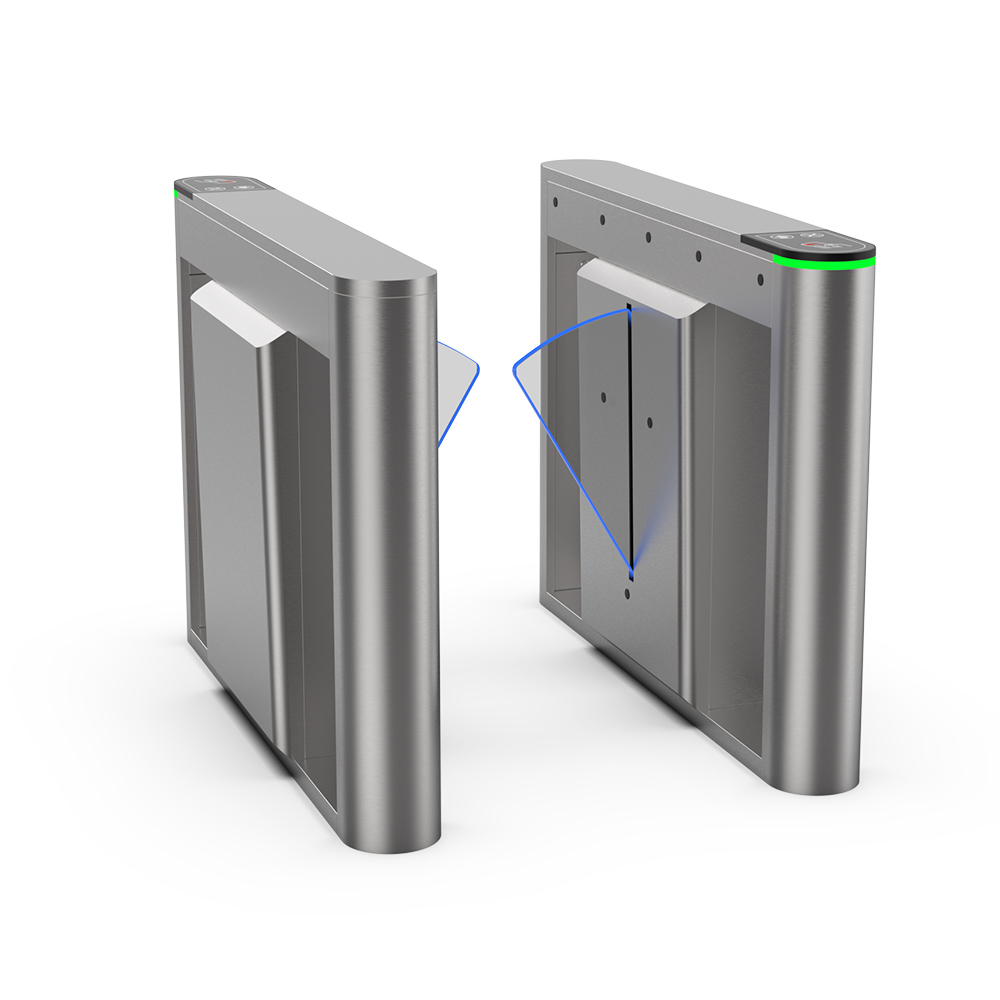
Selecting the right pedestrian access control solution for high-traffic entrances is more than just choosing a gate—it's about balancing security requirements, passenger flow efficiency, user experience, and long-term operational costs. Two of the most prominent solutions in this space are flap barriers (often called flap barrier turnstiles) and speed gates (also known as optical turnstiles).
While both serve the fundamental purpose of regulating authorized entry, their operational principles, physical characteristics, and ideal applications differ significantly. This comprehensive comparison will guide facility managers, security consultants, and system integrators through the essential factors to consider when choosing between these two sophisticated barrier gate access control system options.
A flap barrier system, sometimes referred to as a swing flap barrier or retractable flap barrier, is a physical barrier system that uses motorized, swing-wing panels (flaps) to control passage. Upon credential verification (via card, biometrics, etc.), the panels retract or swing open, allowing one person to pass through a single lane flap barrier before closing securely.
Key Characteristics:
Physical Barrier: Presents a clear, imposing physical obstruction.
Motorized Operation: Uses a quiet, brushless motor for smooth opening/closing.
High Security: Excellent anti-tailgating properties due to the solid flaps.
Variants: Includes automatic flap barrier models with full-height or waist-high (flap gate barrier) designs.
A speed gate is a type of optical turnstile that uses retracting glass or acrylic barriers (often called "wings" or "paddles"). These barriers are typically sleek and can retract with exceptional speed. They are designed for very high-throughput environments where a physical "lock" is desired but with faster cycle times than traditional turnstiles.
Key Characteristics:
Optical/Sensing Barrier: Relies more on sensor detection than brute-force physical blocking.
Ultra-Fast Cycle: Can achieve passage rates of up to 40-60 people per minute per lane.
Modern Aesthetics: Features a sleek, transparent design that maintains visual openness.
Controlled Force: Barriers apply minimal force, prioritizing speed and safety.
To make an informed decision, let's compare the two across critical dimensions for high-traffic scenarios.
Feature | Flap Barrier | Speed Gate |
Primary Strength | Physical Security & Deterrence | High-Speed Passenger Flow |
Passage Speed | Good (20-35 persons/min) - Physically robust cycle. | Excellent (40-60+ persons/min) - Optimized for rapid transit. |
Physical Presence | High - Solid panels signal a strong security perimeter. | Moderate/Low - Glass barriers are imposing but less obstructive visually. |
Anti-Tailgating | Excellent - Solid flaps physically prevent following. | Very Good - Uses multiple infrared sensor arrays to detect tailgating. |
Durability & Vandalism | Excellent - SUS304 stainless steel construction withstands impact (IK10 rated). | Good - Tempered glass is strong, but may be more vulnerable to targeted vandalism. |
User Experience | Clear, Deliberate Passage - Users wait for a clear physical opening. | Fast, Fluid Passage - Aimed at creating a seamless walk-through experience. |
Emergency Egress | Excellent - Flaps typically have a push-through (panic) function or drop automatically. | Excellent - Barriers retract instantly upon power loss or emergency signal. |
Ideal Application | Where security is paramount: Metro pay zones, airport security portals, data centers, high-security offices. | Where flow & aesthetics are key: Corporate lobbies, office building turnstiles, conference centers, modern transport hubs. |
Aesthetic Impact | Industrial/Solid - Projects strength and security. | Modern/Sleek - Projects innovation and openness. |
Integration | Both integrate seamlessly with advanced flap barrier access control systems, facial recognition, and visitor management software. |
Ask these questions about your specific project:
What is Your Security Priority Level?
Choose Flap Barrier if: You require a definitive, physical barrier that deters unauthorized entry attempts and provides the highest level of perimeter security. It's the clear choice for access control barrier gates in sensitive areas.
Choose Speed Gate if: Security is important, but you prioritize rapid, authorized flow and a less imposing physical presence. Excellent for "employee filtering" in corporate settings.
What is Your Peak Person-Per-Minute (PPM) Requirement?
Choose Flap Barrier if: Your peak flow is within moderate ranges (e.g., metro station off-peak, controlled office entry).
Choose Speed Gate if: You need to process very high volumes of people quickly, such during morning rush hour in a large office tower or at a major event entrance.
What is the Desired Aesthetic and User Perception?
Choose Flap Barrier if: You want to communicate "high security" clearly to all users and visitors. Common among flap barrier manufacturers serving institutional clients.
Choose Speed Gate if: You want a modern, architecturally friendly solution that minimizes visual clutter and feels more welcoming to authorized personnel.
What is Your Environment and Risk of Abuse?
Choose Flap Barrier if: The installation is in a public transit area or other setting with a higher risk of vandalism or forceful abuse. Its metal construction is more resilient.
Choose Speed Gate if: The environment is more controlled, like a private corporate campus or a premium office building.
There is no universal "best" option—only the best solution for your specific operational requirements. The choice between a robust flap turnstile gate and a high-velocity speed gate fundamentally comes down to your priority ranking of Security vs. Flow.
For Maximum Security & Deterrence: The physical, unwavering barrier of a flap barrier system makes it the undisputed champion. It is the workhorse for environments where controlling exactly who passes is non-negotiable.
For Maximum Flow & Modern Experience: The sensor-driven, rapid-retraction design of a speed gate provides superior throughput and a more fluid user experience, perfect for modern workplaces where efficiency and aesthetics are highly valued.
Still Unsure? Consult with an Expert System Designer.
The nuances of your floor plan, user demographics, and integration needs with existing barrier gate access control systems can influence the final decision.
Why Partner with DOOR for Your Access Control Solution?
As a leading provider of both high-security flap barriers and high-efficiency speed gates, DOOR offers unbiased consultation. We help you analyze your traffic patterns, security audits, and architectural plans to recommend the optimal solution—or even a hybrid approach—for your high-traffic entrance.
Ready to define the perfect access point for your facility? Contact DOOR today for a professional site assessment and detailed product recommendations.


Headquarters Add.
Factory Add.
Come and Contact DOOR
Quick Links
17th Floor, Block C, Digital Innovation Center, Longhua District, Shenzhen, China
 EN
EN