In the world of pedestrian traffic management, selecting the right turnstile solution can mean the difference between seamless security and operational bottlenecks. As a leading manufacturer with over a decade of experience, DOOR understands that this decision impacts everything from security protocols to architectural aesthetics, operational efficiency to long-term maintenance costs.
This comprehensive guide will help facility managers, security directors, architects, and system integrators make informed decisions between three popular turnstile types: Sliding Turnstiles, Swing Gates, and Speed Gates. We'll explore their unique characteristics, optimal applications, and key considerations for your specific environment.
Quick Comparison: Which Turnstile Fits Your Needs?
Choosing the right turnstile depends on your priorities: Sliding Turnstiles are the best all-rounders for modern offices (quiet & space-saving); Speed Gates are essential for high-traffic hubs like metros; and Swing Gates offer the most cost-effective solution for wider access or industrial sites.
| Comparison Factor | Sliding Turnstile | Swing Gate | Speed Gate |
| Barrier movement | Panels slide into the cabinet | Panels rotate around a pivot | Usually fast swing or retractable panels |
| Installation space | Compact, no swing arc | Requires panel movement clearance | Depends on cabinet and panel structure |
| Passage width | Standard or customizable | Best suited to wider lanes | Standard and accessible lanes available |
| Pedestrian flow | Medium to high | Low to medium | High |
| Anti-tailgating | Sensor-dependent | Basic to advanced | Usually advanced optical detection |
| Accessibility | Custom wide lane available | Commonly used for wide accessible lanes | Accessible lane requires suitable configuration |
| Noise | Generally low | Depends on motor and panel size | Generally low |
| Indoor/outdoor use | Model-dependent | Model-dependent | Mainly indoor unless outdoor-rated |
| Integration | RFID, QR, biometric and access control | RFID, QR, biometric and access control | RFID, QR, biometric and access control |
| Typical applications | Offices, hospitals, premium lobbies | Hospitals, factories, retail and wide lanes | Offices, airports, metro and high-traffic buildings |
| Cost level | Model-dependent | Often more economical | Usually higher due to sensors and control systems |
| Maintenance focus | Sliding mechanism and sensors | Pivot, motor and panel alignment | Optical sensors, motor and control system |
A sliding turnstile uses motor-driven glass or acrylic barrier panels that move horizontally into or alongside the cabinet to open the pedestrian lane. Unlike a swing gate, the panel does not require a wide outward swing arc, which can make the system easier to position in narrow lobbies or entrances where surrounding clearance is limited. Sliding turnstiles are commonly considered for corporate offices, residential buildings, hospitals, government facilities and other controlled indoor entrances that require quiet operation and a modern appearance.
Their main advantages include compact barrier movement, flexible access control integration and the ability to configure passage width, panel height, sensors and identification devices according to project requirements. However, suitability still depends on the selected model, installation environment, maintenance access, pedestrian traffic and required security level. A sliding turnstile should not automatically be considered more secure or more economical than every other gate type.
Explore our sliding turnstile systems to compare available configurations. For a specific product example, review the SL92 sliding turnstile and confirm its dimensions, passage width, operating speed, sensor layout and interface options against your project requirements.
A swing gate uses one or two barrier panels that rotate around a vertical pivot. The panel width can usually be adjusted to create a standard pedestrian lane or a wider accessible lane for wheelchairs, luggage, carts and equipment.
This flexibility makes swing gates suitable for hospitals, office buildings, factories, schools, retail entrances and reception areas. Project planners can review our automatic swing gate systems for different cabinet designs, lane widths and access control options.
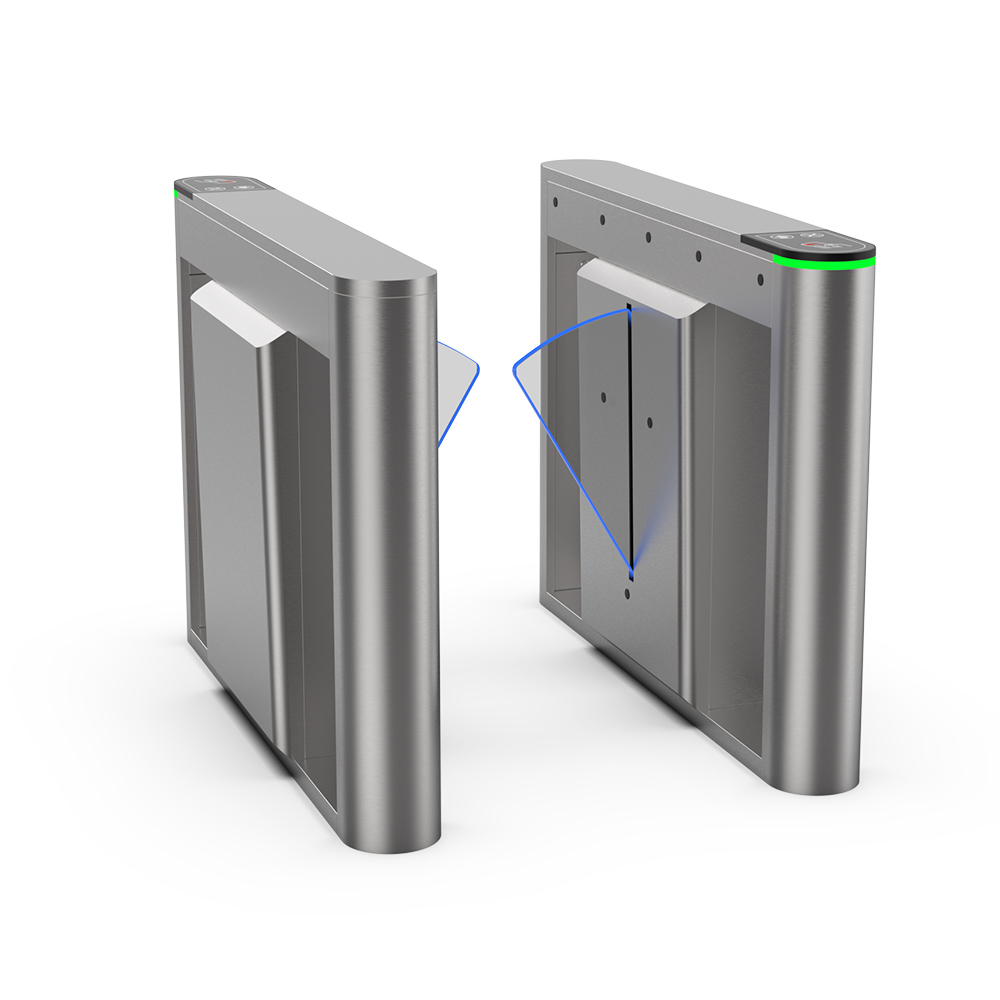
A speed gate is an optical pedestrian access gate that combines fast motor-driven barrier panels with infrared or optical sensors. Depending on the model, the panels may swing open or retract into the cabinet.
Speed gates are commonly used in office towers, airports, metro stations, corporate campuses and other locations where fast pedestrian flow, identity verification and anti-tailgating detection are required. View our speed gate turnstiles to compare models for different traffic levels and installation environments.
Feature | Sliding Turnstile | Swing Gate | Speed Gate |
Installation Depth | 280-400mm | 500-800mm | 300-600mm |
Clearance Arc | None required | 90-120° arc | Minimal |
Best For Tight Spaces | Excellent | Poor | Good |
Metric | Sliding Turnstile | Swing Gate | Speed Gate |
Cycles/Hour | 1,500-2,000 | 800-1,200 | 3,000-4,000 |
Noise Level | 40-50 dB | 50-60 dB | 45-55 dB |
Power Consumption | 100-150W | 80-120W | 120-180W |
ADA Compliance | Customizable | Standard | Available |
Security Aspect | Sliding Turnstile | Swing Gate | Speed Gate |
Anti-Tailgating | Advanced | Basic | Advanced |
Forced Entry Resistance | High | Medium | Medium-High |
Integration Complexity | Low-Medium | Low | Medium-High |
Visual Deterrence | High | Medium | High |
Cost Factor | Sliding Turnstile | Swing Gate | Speed Gate |
Initial Investment | $$-$$$ | $-$$ | $$$-$$$$ |
Maintenance Cost/Year | $ | $$ | $$-$$$ |
Energy Cost/Year | $ | $ | $$ |
Total Cost of Ownership | $$ | $$-$$$ | $$$ |
Answer these critical questions:
What is your peak hourly traffic?
< 500 persons/hour: All options suitable
500-1,500 persons/hour: Consider sliding or speed gates
1,500 persons/hour: Speed gates recommended
What are your spatial constraints?
Tight corridors/lobbies: Sliding turnstiles
Ample space: Swing gates
Modern open layouts: Speed gates
What is your security level requirement?
Basic access control: Swing gates
Medium security with aesthetics: Sliding turnstiles
High throughput with security: Speed gates
Indoor vs. Outdoor: Sliding and speed gates typically excel indoors; swing gates are often more weather-resistant for outdoor use
Architectural style: Modern/minimalist designs pair best with sliding or speed gates
Noise sensitivity: Healthcare and libraries favor sliding turnstiles
Existing systems: Ensure compatibility with your access control software
Future expansion: Modular designs (like DOOR's sliding turnstiles) offer easier upgrades
Multi-system integration: Consider gates that interface with visitor management, CCTV, and building automation
Don't just consider purchase price. Factor in:
Installation complexity and cost
Expected maintenance frequency and cost
Energy consumption
Expected lifespan (DOOR sliding turnstiles offer 5-8 years minimum)
Warranty coverage and support availability
| Application | Recommended Configuration | Main Reason |
| Corporate office lobby | Speed gate or sliding turnstile | Appearance, quiet operation and controlled employee access |
| Airport or metro station | Speed gate or project-specific e-gate | High traffic and system integration |
| Hospital | Swing accessible lane plus controlled standard lanes | Wheelchair, patient and equipment access |
| Factory or warehouse | Swing gate or heavy-duty pedestrian gate | Wide passage and practical access |
| School or university | Speed gate, swing gate or mixed lanes | Peak traffic and visitor management |
| Stadium | High-throughput gate system based on crowd calculations | Peak entry volume and event security |
| Residential building | Sliding or swing gate | Quiet operation and resident access |
| Government facility | Configuration based on verified security level | Identity verification and controlled entry |
Choosing DOOR means more than selecting hardware—it's partnering with a complete solution provider:
Vertical integration: We control the manufacturing process from component production to final assembly
Quality assurance: Every turnstile undergoes 72-hour continuous operation testing before shipment
Customization capability: From color matching to specific dimension requirements
Pre-sale consultation: Free project analysis and recommendation
Integration expertise: Experience with 100+ access control and security systems
Global support network: 24/7 technical assistance with local language support
Modular architecture: Easily upgrade components as technology evolves
Software compatibility: Regular firmware updates for emerging protocols
Scalable solutions: Systems that grow with your facility needs
Prioritizing Price Over Total Cost: The cheapest option often costs more in maintenance and replacement
Ignoring Throughput Calculations: Underestimating peak traffic causes bottlenecks
Overlooking Integration Requirements: Ensure compatibility before purchase
Neglecting Maintenance Access: Consider service requirements in installation planning
Forgetting About Aesthetics: The turnstile becomes part of your building's identity
Request a Site Assessment: Contact DOOR for a free evaluation of your specific needs
Download Technical Specifications: Compare detailed specs of each turnstile type
Schedule a Demo: Experience the operation differences firsthand
Consult with Peers: Review case studies from similar facilities
Plan for Integration: Involve your IT/security team early in the process
The decision between sliding, swing, and speed gate turnstiles ultimately depends on your unique combination of space constraints, traffic patterns, security requirements, aesthetic preferences, and budget considerations.
For most modern commercial applications, sliding turnstiles represent the optimal balance—offering space efficiency, quiet operation, sophisticated security features, and architectural compatibility. Their slightly higher initial investment is typically offset by lower long-term maintenance costs and superior user experience.
As a manufacturer committed to innovation, Shenzhen DOOR continues to advance each technology. Our sliding turnstiles now incorporate AI-powered anti-tailgating algorithms, our swing gates feature enhanced durability for harsh environments, and our speed gates achieve industry-leading throughput without compromising security.
The right choice today will serve your facility for years to come. Make it with comprehensive information and expert guidance.
The right pedestrian gate should be selected according to peak traffic, clear passage width, required security level, access control method, operating environment and emergency operation requirements.
To receive a suitable recommendation, please provide your project application, required lane quantity, passage width, expected daily traffic, preferred verification method and installation environment. You can discuss your access control project with the DOOR team and request a project-specific gate configuration.
A: The Sliding Turnstile is the optimal choice for small lobbies. Unlike swing gates that require an 800mm+ clearance arc, sliding panels retract into the pedestal, saving significant floor space while maintaining a high-end, professional aesthetic.
A: A high-quality sliding gate turnstile, such as those manufactured by DOOR, typically has a lifespan of 8 to 10 years with regular maintenance. Our systems are tested for over 5 million opening/closing cycles to ensure long-term durability in high-traffic environments.
A: Yes. Modern speed gates and sliding turnstiles are designed with universal integration interfaces. They can seamlessly connect with facial recognition, RFID readers, QR code scanners, and even thermal screening systems for enhanced security.
A: Absolutely. Swing gates are the standard solution for ADA (Americans with Disabilities Act) compliance. Their ability to provide a wider passage width (typically 900mm+) makes them ideal for wheelchair access and large delivery items.
A: The primary maintenance involves cleaning the optical sensors to prevent dust interference, checking the alignment of the retractable barriers, and updating the control software. We recommend a professional inspection every 6-12 months.


Headquarters Add.
Factory Add.
Come and Contact DOOR
Quick Links
17th Floor, Block C, Digital Innovation Center, Longhua District, Shenzhen, China
 EN
EN